
Automation

Routing the Right Information to the Right People at the Right Time

Context-rich, deduplicated operational alerting workflows that bridge facility operations and IT engineering to accelerate incident resolution.

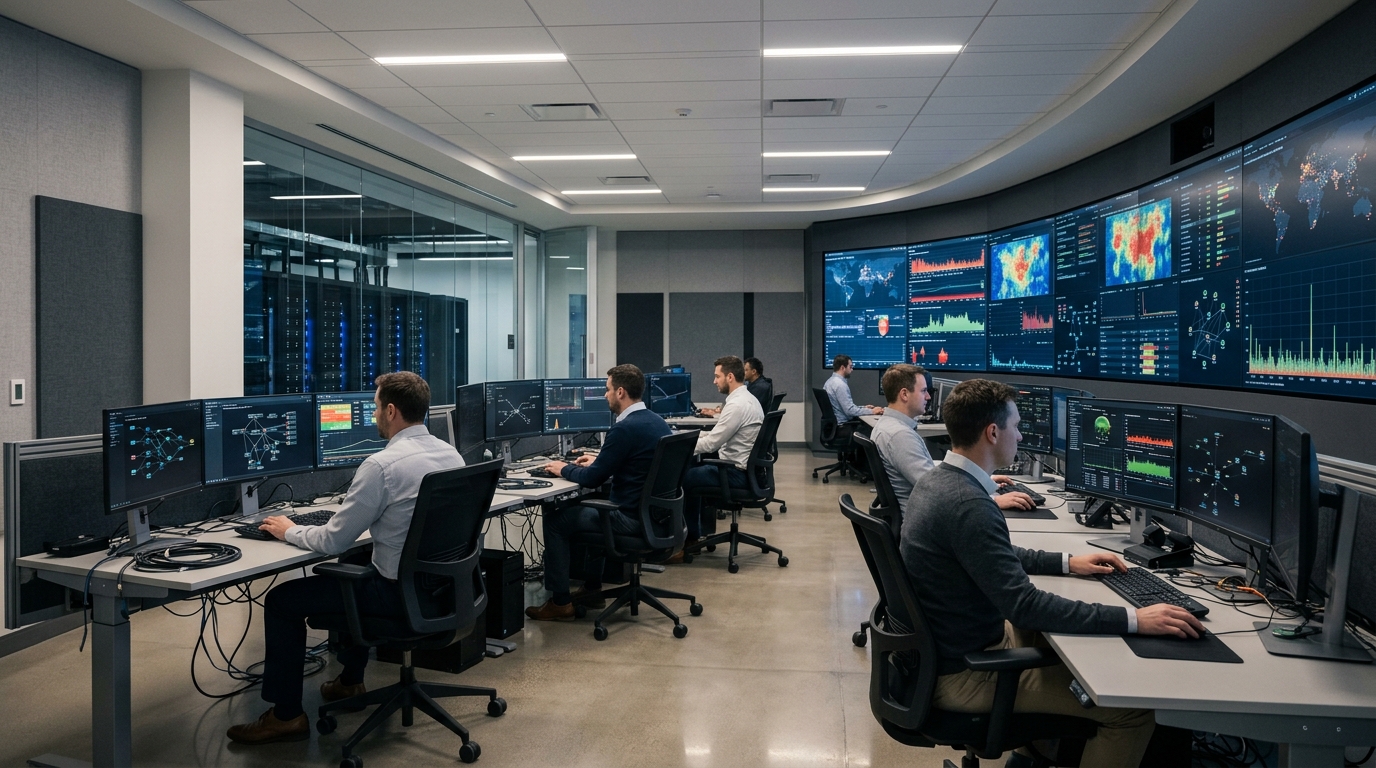
Enterprise data center network operations center with telemetry monitoring workstations
NETWORK OPERATIONS CENTER & TELEMETRY MONITORING (ILLUSTRATIVE)NOC OPERATIONS
01 //

Structured, Contextual Notifications

When a critical infrastructure event occurs, receiving a generic text message stating 'Temperature High' is useless to an on-call engineer. Responders need actionable context: exactly which rack, which server, the specific component, upstream dependencies, and recommended remediation runbooks.

GreenNext specifies a structured alerting pipeline that enriches incoming alerts with real-time operational context before routing them to appropriate response teams:

SEVERITY GRADING

Four-Tier Incident Classification

Standardized classification: P1 Critical (immediate service degradation), P2 Major (redundancy lost), P3 Minor (degradation trend), and P4 Info (informational logs).

ALERT ENRICHMENT

Contextual Telemetry Bundling

Automatically appending 15-minute historical trend graphs, physical rack elevation maps, and upstream circuit diagrams to every outgoing incident notification.

STORM SUPPRESSION

Root-Cause Deduplication

Suppressing thousands of downstream server alarms when an upstream circuit breaker trips, presenting engineers with a single unified incident ticket.

ENTERPRISE INTEGRATION

Multi-Channel Incident Dispatch

Bidirectional integration with enterprise incident platforms (PagerDuty, ServiceNow, Opsgenie, Jira) and operational Slack/Teams engineering war rooms.

02 //

Automated Escalation & Runbook Execution

If an unacknowledged P1 incident exceeds defined SLA thresholds, the system automatically escalates through tiered engineering rosters while executing pre-authorized fail-safe runbooks—such as gracefully shifting batch Kubernetes workloads away from an overheating rack row.

Next Step in Lifecycle

Continue Exploring Automation

Examine Capacity Management →
Start a Conversation

Build the Next Generation of Digital Infrastructure

If you are involved in infrastructure planning, data center operations, AI workload management, or regional digital development across South India, we want to understand your requirements.

KPI 7 — Equipment Population Reliability

Mean Time Between Failures (MTBF) Calculator

Measures the statistical operational reliability for a repairable equipment cohort over an observation period.

Formula: MTBF = (Fleet Population × Observation Hours) ÷ Number of Qualifying Failures
E.g. 100 CRAH units, 20 UPS modules, or 500 PDU circuits
8,760 hours = 1 non-leap calendar year
Excludes scheduled preventive maintenance outages
Cohort MTBF Output
219,000 hrs

≈ 9125.0 operating days per failure across cohort

Total Cumulative Operating Hours (T):876,000 unit-hrs
Annualized Failure Rate (λ):4.57 FITs
Statistical Model:Observed Constant Failure Rate

Caveat: MTBF assumes a constant failure rate (exponential distribution) during the useful life phase. It does not reflect infant mortality or end-of-life wear-out wear mechanisms.

KPI 8 — Incident Response & Restoration Efficiency

Mean Time To Repair (MTTR) & Incident Lifecycle Decomposition

Measures maintainability and service restoration velocity from telemetry alert to operational sign-off.

Formula: MTTR = Total Qualifying Repair / Outage Time ÷ Qualifying Incidents

High-Level MTTR Calculator

Calculated Mean Time To Repair
2.00 hours (120 min)

Average incident resolution duration across 3 qualifying event(s).

Incident Timeline DecompositionTotal: 120 min

m
m
m
m
m
Phase Contribution to Outage Window:
Detect Triage Dispatch Repair Verify
Operational Distinction: True MTTR can refer strictly to hands-on maintenance technician wrench time, whereas Mean Time to Service Restoration (MTSR) includes telemetry detection, on-call dispatch, replacement part retrieval, hot-swap, and commission testing. Clear SLA contracts specify which boundary defines contractual penalties.