
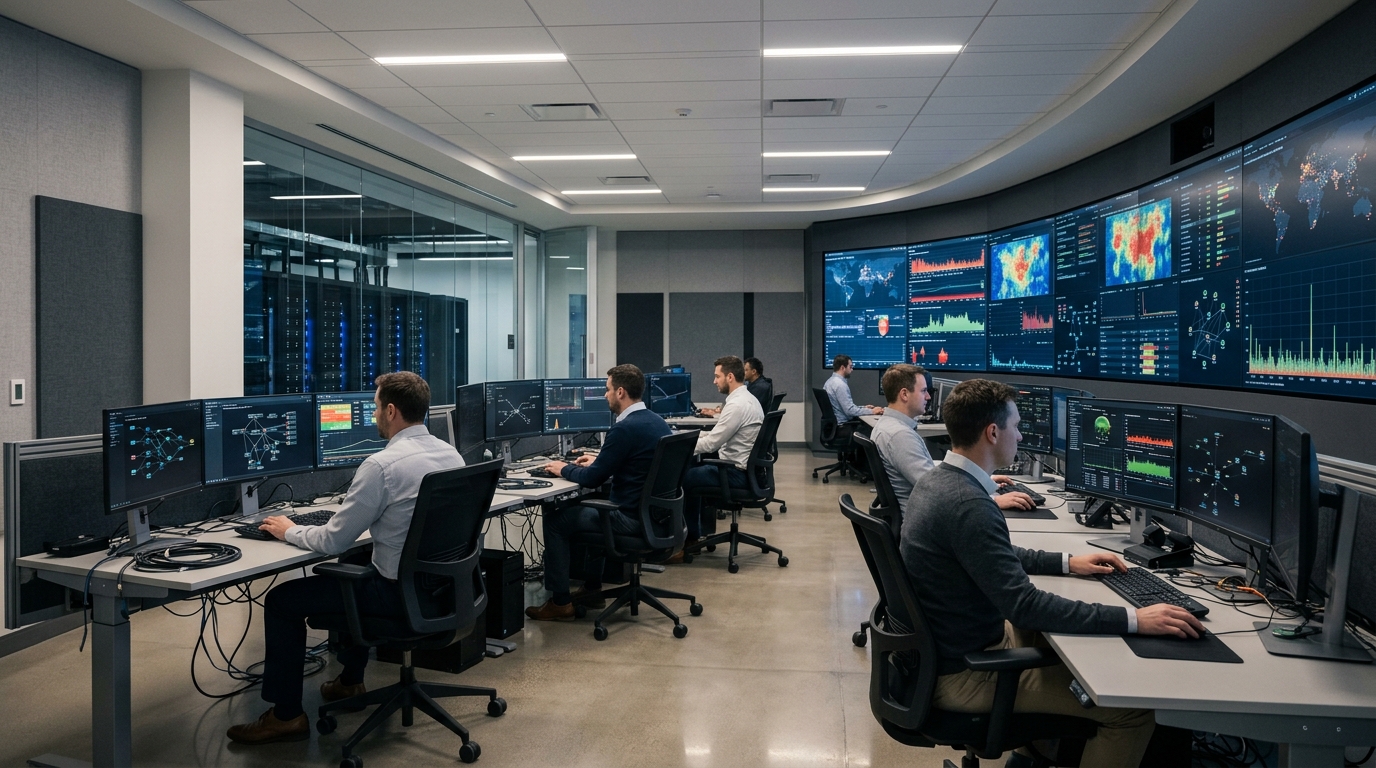
The 6-Step Operational Workflow
As data center complexity multiplies with the adoption of high-density liquid cooling, multi-tier power distribution, and multi-tenant AI clusters, human operators can no longer manually monitor millions of incoming telemetry points. Operational stability requires an automated pipeline that ingests raw telemetry, filters noise, assesses risk, and triggers coordinated responses.
GreenNext structures facility and IT infrastructure operations around a closed-loop six-step operational workflow:
01. Monitor
High-frequency multi-protocol telemetry ingestion spanning Modbus, BACnet, SNMP, Redfish, and streaming network telemetry across all physical and logical systems.
02. Detect
Real-time stream processing applying statistical process control, threshold hysteresis, and multivariate correlation to flag deviations from normal baselines.
03. Analyze
Correlating localized alerts with upstream electrical, thermal, and network dependencies to isolate root causes and eliminate cascading alarm storms.
04. Decide
Evaluating policy-driven runbooks to determine whether an anomaly warrants human intervention, automated workload throttling, or mechanical setpoint adjustment.
05. Automate
Triggering deterministic control actions: modulating CDU pump curves, shifting non-urgent batch jobs, or isolating compromised network ports.
06. Report
Generating immutable audit trails, SLA compliance logs, and executive operational summaries to ensure transparency and continuous improvement.
Benefits of Telemetry Automation
Transitioning to automated, closed-loop infrastructure management delivers tangible operational advantages: