
AutomationConceptual Specification

Operational Discipline, Change Governance, and Field Maintainability for Mission-Critical Facilities

Standardized operating procedures, 24/7/365 multi-disciplinary staffing models, formal Methods of Procedure (MOP) change governance, OSHA Lockout/Tagout (LOTO) safety protocols, and telemetry-integrated CMMS maintenance.

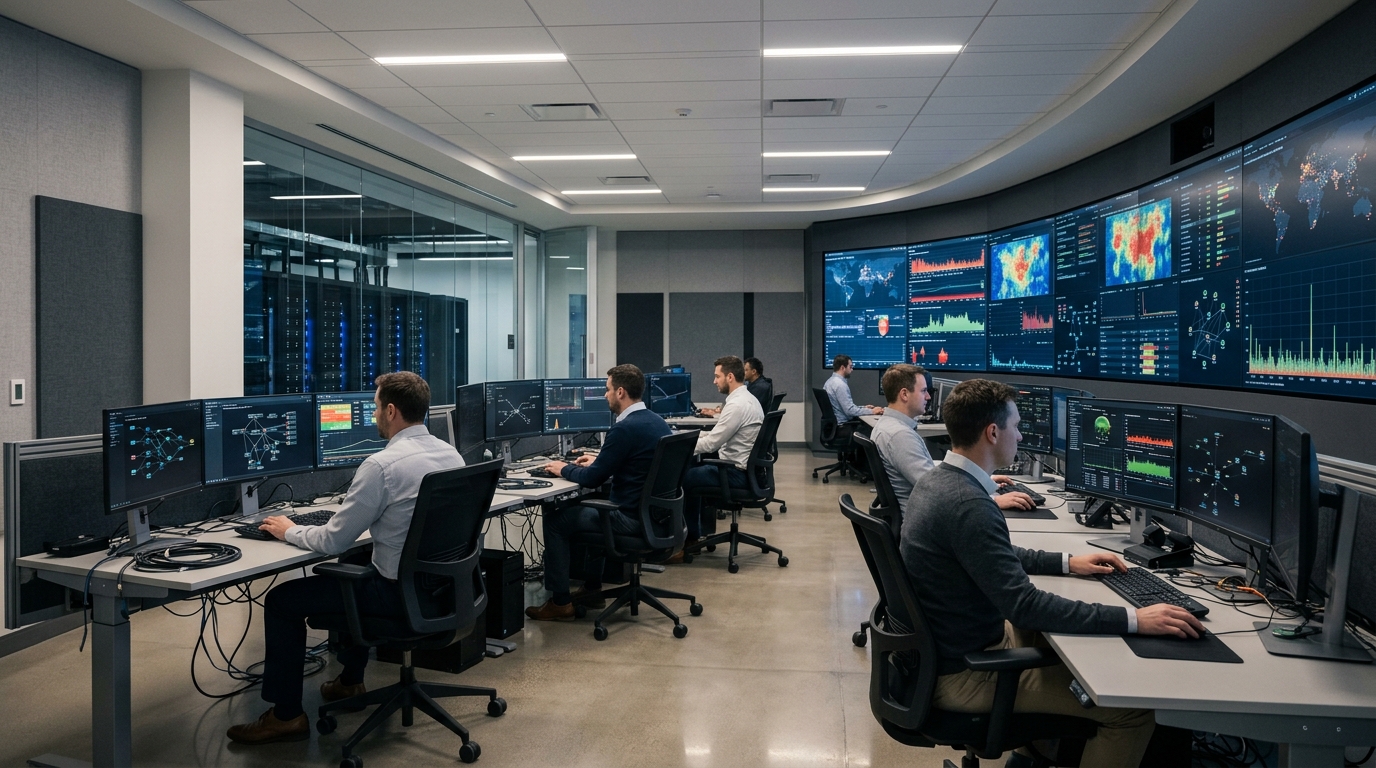
Enterprise data center network operations center with telemetry monitoring workstations
NETWORK OPERATIONS CENTER & TELEMETRY MONITORING (ILLUSTRATIVE)NOC OPERATIONS
01 //

Method of Procedure (MOP) & Standard Operating Procedures (SOP)

Industry data shows that over 70% of mission-critical data center service interruptions stem from human error during maintenance, switching operations, or procedural non-compliance. High availability cannot rely solely on redundant hardware; it demands institutionalized operating discipline.

GreenNext defines structured operational governance frameworks that transform field maintenance from ad-hoc procedures into deterministic, peer-reviewed workflows. Every activity affecting physical electrical feeds, cooling loops, or network paths is governed by formal Method of Procedure (MOP) documentation.

Operational Advisory & Field Boundaries: GreenNext develops digital operations workflows, automation playbooks, and procedural architectures. GreenNext does not provide direct outsourced facilities management (FM) personnel or physical remote-hands field staffing. On-site critical operations must be executed by qualified, certified critical facility engineers.
CHANGE GOVERNANCE

Method of Procedure (MOP) Rigor

Step-by-step verified execution scripts detailing isolation points, rollback contingencies, safety interlocks, and peer sign-offs for all live physical changes.

ROUTINE PLAYBOOKS

Standard Operating Procedures (SOP)

Exhaustive operational guides covering routine plant management: UPS battery impedance testing, generator run-ups, chiller rotations, and filter replacements.

CRISIS MITIGATION

Emergency Operating Procedures (EOP)

Deterministic runbooks for rapid isolation of sudden anomalies: primary utility loss, CDU coolant leaks, cooling loop pressure drops, and electrical arc events.

ASSET INTELLIGENCE

CMMS & Preventative Scheduling

Computerized Maintenance Management System tracking equipment mean time between failures (MTBF), OEM service intervals, and critical spare parts inventory.

02 //

Electrical Safety, Failure Isolation & Lockout/Tagout (LOTO)

Operating high-voltage switchgear, multi-megawatt UPS arrays, and high-amperage 48V DC busbars requires rigorous adherence to personal electrical safety protocols. Arc flash hazards in high-density facilities can generate temperatures exceeding 19,000°C, requiring uncompromising isolation discipline.

GreenNext frameworks align with NFPA 70E (Standard for Electrical Safety in the Workplace) and OSHA 1910.147 Lockout/Tagout standards. Maintenance procedures enforce dual-technician verification, calibrated zero-energy test protocols, and calibrated arc-rated Personal Protective Equipment (PPE) appropriate to calculated incident energy levels.

ELECTRICAL ISOLATION

Lockout/Tagout (LOTO) Discipline

Standardized multi-padlock isolation protocols ensuring de-energized electrical switchboards and valves cannot be re-energized during active maintenance.

ARC FLASH SAFETY

Incident Energy & PPE Boundaries

Enforcement of arc flash danger boundaries and NFPA 70E PPE Category 1–4 gear requirements based on short-circuit and protective relay coordination studies.

TWO-PERSON VERIFICATION

Dual-Operator Verification

Mandatory presence of a qualified peer reviewer to cross-check switching steps, confirm zero-voltage with calibrated meters, and oversee safety clearances.

HOT WORK CONTROL

Permit-to-Work (PTW) Governance

Formal digital permit-to-work issuance requiring risk assessments, environmental checks, and fire-watch monitoring before any soldering, welding, or cutting.

03 //

24/7/365 Staffing Models, Competency & Incident RCA

Sustained continuous uptime requires structured organizational readiness, continuous skill development, and blameless post-incident learning cycles.

Tiered 24/7/365 shift staffing combining on-site critical facilities engineers (CFEs) with centralized remote telemetry operations monitoring
Quarterly emergency simulation drills testing shift operator response times to simulated utility blackouts, cooling loop depressurization, and fire alarms
OEM remote-hands and service-level agreements guaranteeing 2-hour to 4-hour on-site specialized technician arrival for major plant failure emergencies
Standardized shift handover protocols documenting active maintenance permits, bypassed sensor points, fluid reservoir levels, and ongoing weather advisories
Structured Root Cause Analysis (RCA) methodology using 5-Why and Ishikawa diagrams for all operational anomalies, culminating in tracked corrective actions
Next Step in Lifecycle

Continue Exploring Automation

Review Commissioning Lifecycle →
Start a Conversation

Build the Next Generation of Digital Infrastructure

If you are involved in infrastructure planning, data center operations, AI workload management, or regional digital development across South India, we want to understand your requirements.

KPI 10 — Operational Discipline & Asset Maintenance

Preventive Maintenance Compliance (PMC) & Planned Work Ratio

World-Class (≥90%)
Formulas:

PMC (%) = (Preventive Maintenance Tasks Completed On Time ÷ Total PM Tasks Due) × 100

PMP (%) = (Planned Maintenance Labor Hours ÷ Total Maintenance Labor Hours) × 100

Preventive Maintenance Schedule Compliance

Preventive Maintenance Compliance (PMC)
91.1%

41 of 45 scheduled work orders executed within OEM/site SLA window.

Planned vs Reactive Labor Ratio (PMP)

Planned Maintenance Percentage (PMP)
90.0%

Industry benchmark: >85% planned activity signals pro-active risk mitigation vs fire-fighting.

Illustrative Method of Procedure (MOP) Execution Log

WO #Asset & DescriptionDisciplineFrequencyDue DateMOP ValidatedExecution Status
PM-2026-081UPS-A1 (Static Inverter & Capacitor Bank)Power DistributionMonthly2026-10-15✓ VerifiedCompleted On-Time
PM-2026-082CRAH-04 (EC Fan Belt & Valve Actuator)Cooling InfrastructureQuarterly2026-10-16✓ VerifiedCompleted On-Time
PM-2026-083Generator GEN-02 (Load Bank Run & Fuel Polish)Emergency GenerationMonthly2026-10-18✓ VerifiedLate Execution
PM-2026-084VESDA Aspirating Smoke Detector Chamber CleanFire ProtectionSemi-Annual2026-10-20✓ VerifiedCompleted On-Time
PM-2026-085Chilled Water Primary Pump P-101 Bearing LubeCooling PlantQuarterly2026-10-21Pending signoffOverdue / Backlog
CMMS Integration Notice: The figures above represent an interactive demonstration of computerized maintenance management system (CMMS) tracking principles. Live deployment requires API integration with an enterprise CMMS (such as IBM Maximo, SAP PM, or ServiceNow) with validated timestamp audit trails.
KPI 7 — Equipment Population Reliability

Mean Time Between Failures (MTBF) Calculator

Measures the statistical operational reliability for a repairable equipment cohort over an observation period.

Formula: MTBF = (Fleet Population × Observation Hours) ÷ Number of Qualifying Failures
E.g. 100 CRAH units, 20 UPS modules, or 500 PDU circuits
8,760 hours = 1 non-leap calendar year
Excludes scheduled preventive maintenance outages
Cohort MTBF Output
219,000 hrs

≈ 9125.0 operating days per failure across cohort

Total Cumulative Operating Hours (T):876,000 unit-hrs
Annualized Failure Rate (λ):4.57 FITs
Statistical Model:Observed Constant Failure Rate

Caveat: MTBF assumes a constant failure rate (exponential distribution) during the useful life phase. It does not reflect infant mortality or end-of-life wear-out wear mechanisms.

KPI 8 — Incident Response & Restoration Efficiency

Mean Time To Repair (MTTR) & Incident Lifecycle Decomposition

Measures maintainability and service restoration velocity from telemetry alert to operational sign-off.

Formula: MTTR = Total Qualifying Repair / Outage Time ÷ Qualifying Incidents

High-Level MTTR Calculator

Calculated Mean Time To Repair
2.00 hours (120 min)

Average incident resolution duration across 3 qualifying event(s).

Incident Timeline DecompositionTotal: 120 min

m
m
m
m
m
Phase Contribution to Outage Window:
Detect Triage Dispatch Repair Verify
Operational Distinction: True MTTR can refer strictly to hands-on maintenance technician wrench time, whereas Mean Time to Service Restoration (MTSR) includes telemetry detection, on-call dispatch, replacement part retrieval, hot-swap, and commission testing. Clear SLA contracts specify which boundary defines contractual penalties.