
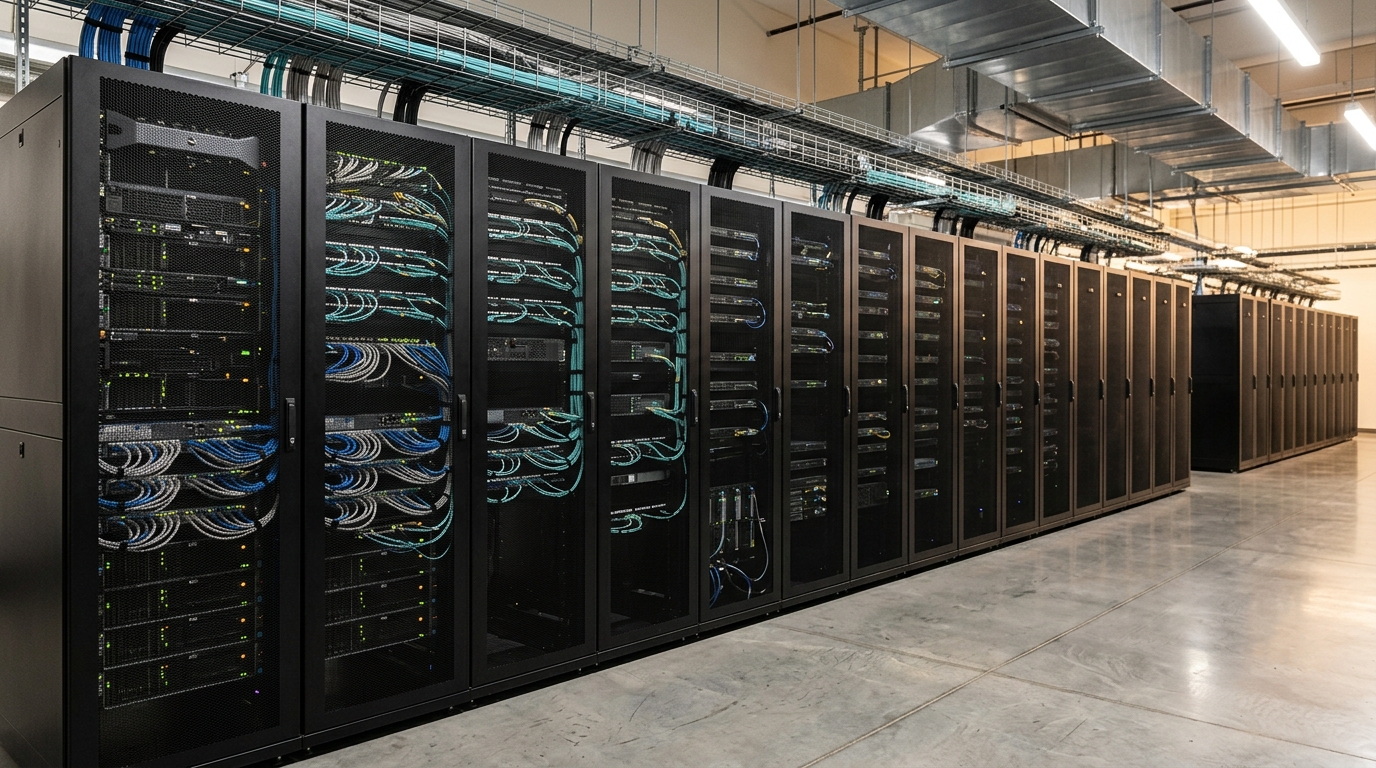
GPU-Intensive Workloads and Extreme Density Compute
Modern deep learning training clusters incorporating high-end GPU and accelerator silicon operate under extreme electrical and thermal conditions. Server chassis consuming 10 kW to 15 kW each push rack densities to 40 kW, 80 kW, or even 130+ kW per enclosure.
These workloads exhibit severe transient load characteristics: synchronized collective communication phases cause sudden megawatt-scale power swings in milliseconds, placing intense stress on voltage regulation modules and upstream power infrastructure.
40 kW to 130+ kW Racks
Engineering physical enclosures, 48V DC busway delivery, and coolant manifold routing for dense accelerator clusters.
Dynamic di/dt Management
Mitigating voltage drops and transformer ringing caused by synchronized GPU execution phases and checkpoint writing.
Bursty Computation Patterns
Harmonizing batch compute scheduling with facility cooling thermal inertia to prevent localized thermal throttling.
Power Availability, Medium-Voltage Substations & Dynamic Load Scheduling
Securing 20 MW to 100+ MW of dedicated electrical grid capacity is often the primary bottleneck for new AI superclusters. Planners must evaluate on-site medium-voltage substations, dedicated 110 kV/230 kV utility lines, and energy storage buffers.
GreenNext provides analytical models that coordinate compute job schedulers (such as Slurm or Kubernetes) with available substation headroom and ambient thermodynamic conditions, enabling intelligent peak-load shaving without sacrificing training throughput.
Dedicated Utility Interconnects
Evaluating medium-voltage transformer kVA ratings, gas-insulated switchgear (GIS), and on-site dual substation feeds.
Workload-Aware Power Headroom
Throttling or re-queuing non-critical background jobs during utility peak-demand windows to avoid demand charge penalties.
Battery Energy Storage Buffers
Deploying lithium iron phosphate (LFP) battery systems to absorb transient step-loads and provide fast-acting frequency response.
Direct-to-Chip (D2C) & Immersion Thermal Topologies
Air cooling cannot dissipate heat fluxes exceeding 50 to 100 W/cm² at modern accelerator dies. Hyperscale AI facilities require direct-to-chip (D2C) cold plates or precision immersion cooling topologies.
GreenNext models the thermodynamic dissipation chain: from silicon thermal interface materials (TIM) and micro-channel copper cold plates, through secondary fluid loops that may use ASHRAE W32/W40/W45 water-temperature classes, to outdoor heat dissipation.
Micro-Channel Liquid Blocks
Distributing treated coolant directly across GPU and HBM silicon with flow rates calibrated to prevent localized boiling.
Warm-Water Cooling (up to 45°C)
Eliminating mechanical chillers in favor of dry coolers, drastically reducing parasitic cooling energy and improving PUE.
Wetted Materials & Secondary Chemistry
Preventing galvanic corrosion and biofilm growth across stainless steel, copper, and EPDM elastomer secondary networks.
Network, Storage and Infrastructure Fabric Scaling
Distributed training requires lossless, ultra-low-latency network fabrics spanning thousands of accelerator nodes. Non-blocking leaf-spine architectures utilizing RoCEv2 or InfiniBand NDR/XDR generate substantial optical transceiver heat that requires dedicated airflow containment.
GreenNext integrates network switch rack placement and structured high-density fiber routing into the broader mechanical layout, preventing cable congestion from choking server exhaust pathways.
Reliability and Sustainability Trade-Offs
Hyperscale operators face competing priorities: maximizing accelerator uptime while meeting corporate decarbonization mandates and municipal water conservation regulations.
GreenNext helps engineering teams evaluate trade-offs between evaporative cooling towers (lower PUE, higher water consumption) versus closed-loop dry coolers (higher thermal resilience, zero water consumption), providing balanced environmental modeling.
Relevant GreenNext Solutions & Tools
Explore the verified GreenNext resources and tools engineered for AI infrastructure architects:
Continue Exploring Industries
Build the Next Generation of Digital Infrastructure
If you are involved in infrastructure planning, data center operations, AI workload management, or regional digital development across South India, we want to understand your requirements.