
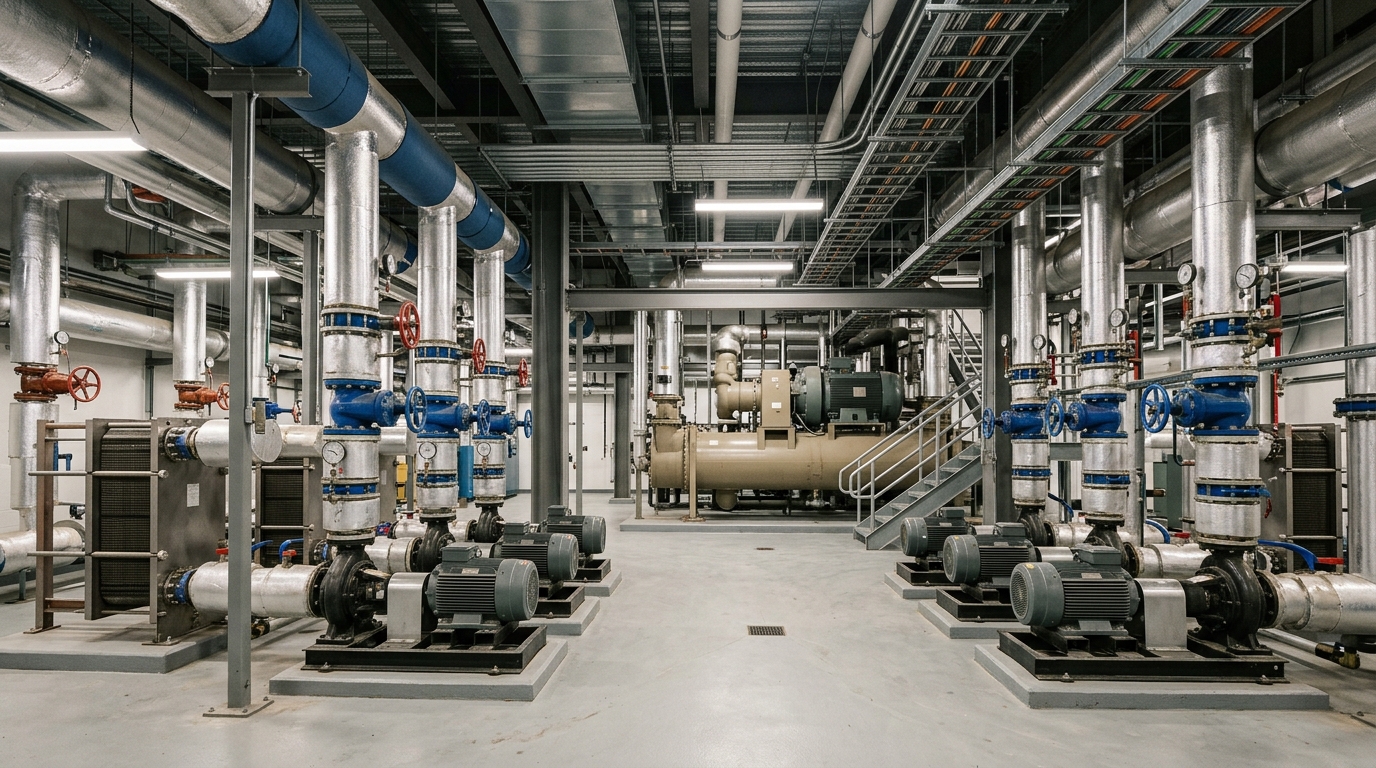
The Problem of Over-Cooling
Cooling infrastructure is often estimated at roughly 30% to 40% of total data center electricity consumption, but the share depends on facility design, climate, operating conditions, and measurement boundary. Legacy designs may over-provision air conditioning to reduce hotspot risk regardless of actual workload intensity.
In high-density AI facilities, air cooling may be insufficient for some silicon heat-flux profiles. GreenNext models hybrid precision thermal architectures that deploy liquid directly to high-heat silicon dies while optimizing residual air cooling for lower-density chassis components; actual performance is configuration-dependent.
Direct-to-Chip Liquid Cooling
Copper micro-channel cold plates mounted directly on GPUs and CPUs can remove a substantial share of rack heat using secondary treated-water loops; the 70–80% planning range is configuration-dependent and not a GreenNext measurement.
Dry Coolers & Free Cooling
Warm-water return loops in the 45°C–50°C range may support compressor-free dry-cooling periods; year-round performance and chiller-run-hour reductions depend on site climate, heat-rejection design, and operating conditions.
Hot-Aisle Containment (HAC)
Rigid structural containment isolating server exhaust air from the room, allowing supply air temperatures to rise to ASHRAE A1/A2 recommended envelopes without risk of thermal recirculation.
Coolant Distribution Units (CDUs)
In-row CDUs equipped with variable-frequency pumps, liquid-to-liquid heat exchangers, particulate filtration, and precision dew-point monitoring.
Closed-Loop Thermal Management & Water Stewardship
In water-stressed regions of South India, conventional evaporative cooling towers consume significant volumes of fresh water daily. GreenNext models closed-loop dry heat-rejection systems that avoid continuous evaporative water consumption during operation when designed for local ambient profiles and facility water temperatures. Actual water usage effectiveness (WUE, ISO/IEC 30134-9) depends on operational boundaries, facility heat rejection designs, and any seasonal adiabatic trim required during extreme temperature peaks.
Continue Exploring Energy
Build the Next Generation of Digital Infrastructure
If you are involved in infrastructure planning, data center operations, AI workload management, or regional digital development across South India, we want to understand your requirements.