
InfrastructureConceptual Specification

Architectural Frameworks for High-Density AI Clusters

Deploying multi-hundred-billion parameter neural networks requires infrastructure that treats power, thermal dissipation, and lossless networking as a single unified operational problem.

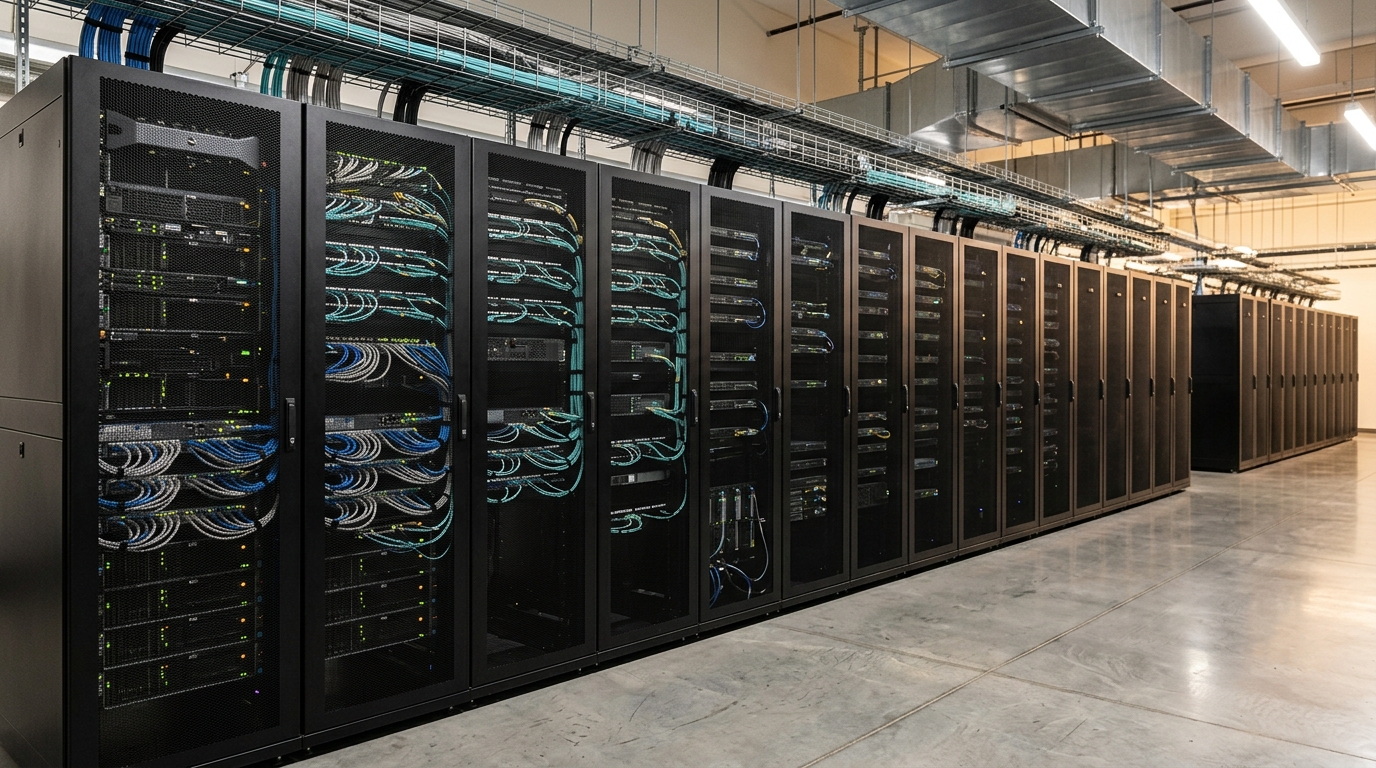
High-density enterprise server racks with organized structured cabling in data center
HIGH-DENSITY AI COMPUTE CLUSTERS (ILLUSTRATIVE)AI COMPUTE RACKS
01 //

The Physics of AI Infrastructure

Modern foundation model training and high-concurrency inference clusters behave fundamentally differently from traditional enterprise virtualization workloads. AI workloads generate sustained, synchronized electrical surges, where thousands of tensor cores simultaneously spike from idle to maximum TDP (700W to 1000W+ per silicon die).

This modeled reference profile can create substantial electrical di/dt transients on facility busways and concentrated heat flux at the silicon die surface; the 80 W/cm² figure is an illustrative planning assumption, not a GreenNext measurement.

Engineering Specification Note: All density benchmarks (40 kW to 100+ kW/rack) describe GreenNext technical reference targets and equipment manufacturer engineering specifications. GreenNext provides architectural modeling and advisory frameworks; we do not operate proprietary colocation facilities.
POWER DENSITY

40 kW – 100+ kW Rack Envelopes

Architectural transitions from 208V/415V AC distribution to 48V DC busbars within the rack frame, minimizing copper I²R resistive losses and eliminating bulky in-rack power supplies.

HEAT REMOVAL

Direct-to-Chip Liquid Cooling

Micro-channel copper cold plates can capture a substantial share of heat directly at the GPU/CPU die; the 70–80% figure and 30°C–35°C supply range are illustrative planning assumptions that depend on equipment and system design.

FABRIC SYNCHRONIZATION

Deterministic Scale-Out Interconnects

Rail-optimized spine-leaf network architectures designed to minimize all-reduce collective communication latency across thousands of distributed accelerator nodes.

02 //

Key Infrastructure Design Requirements

Deploying resilient, high-density AI infrastructure requires adherence to strict engineering parameters:

Secondary Fluid Network (SFN) CDU integration with dual redundant variable-speed circulating pumps
Automated quick-disconnect blind-mate dripless fluid couplings rated for zero-spill maintenance cycles
Transient power surge buffering with localized supercapacitor or lithium-ion battery backup units (BBU)
Lossless Ethernet (RoCEv2) or InfiniBand fabrics configured with strict Explicit Congestion Notification (ECN)
Multi-zone acoustic dampening and high-static-pressure fan arrays for auxiliary DIMM and VRM airflow
Next Step in Lifecycle

Continue Exploring Infrastructure

Explore Compute Architecture →
Start a Conversation

Build the Next Generation of Digital Infrastructure

If you are involved in infrastructure planning, data center operations, AI workload management, or regional digital development across South India, we want to understand your requirements.

Enterprise Technical Infographic• Integrated Systems

AI Compute, Power & Liquid Cooling Co-Design

High-density AI workloads require coordinated planning across accelerator chassis, 415V power distribution, direct-to-chip liquid cooling, and lossless network fabrics.

Active Architectural Inspection

AI workloads

CONCEPTUAL ARCHITECTURE

Frame workload characteristics and duty cycles before sizing dependent infrastructure.

Target Density40kW – 100kW / Rack
Duty Cycle95%+ Sustained Compute
ToleranceZero Packet Drop
Key Engineering Inputs
  • AI model training batch patterns & inference concurrency
  • Per-accelerator power swing profiles (150W idle to 700W+ burst)
  • Strict latency SLA and packet-loss zero tolerance bounds
Factual standard: Conceptual engineering model based on industry reference architectures.
P_Total = P_IT + P_Cooling + P_Electrical_Loss