
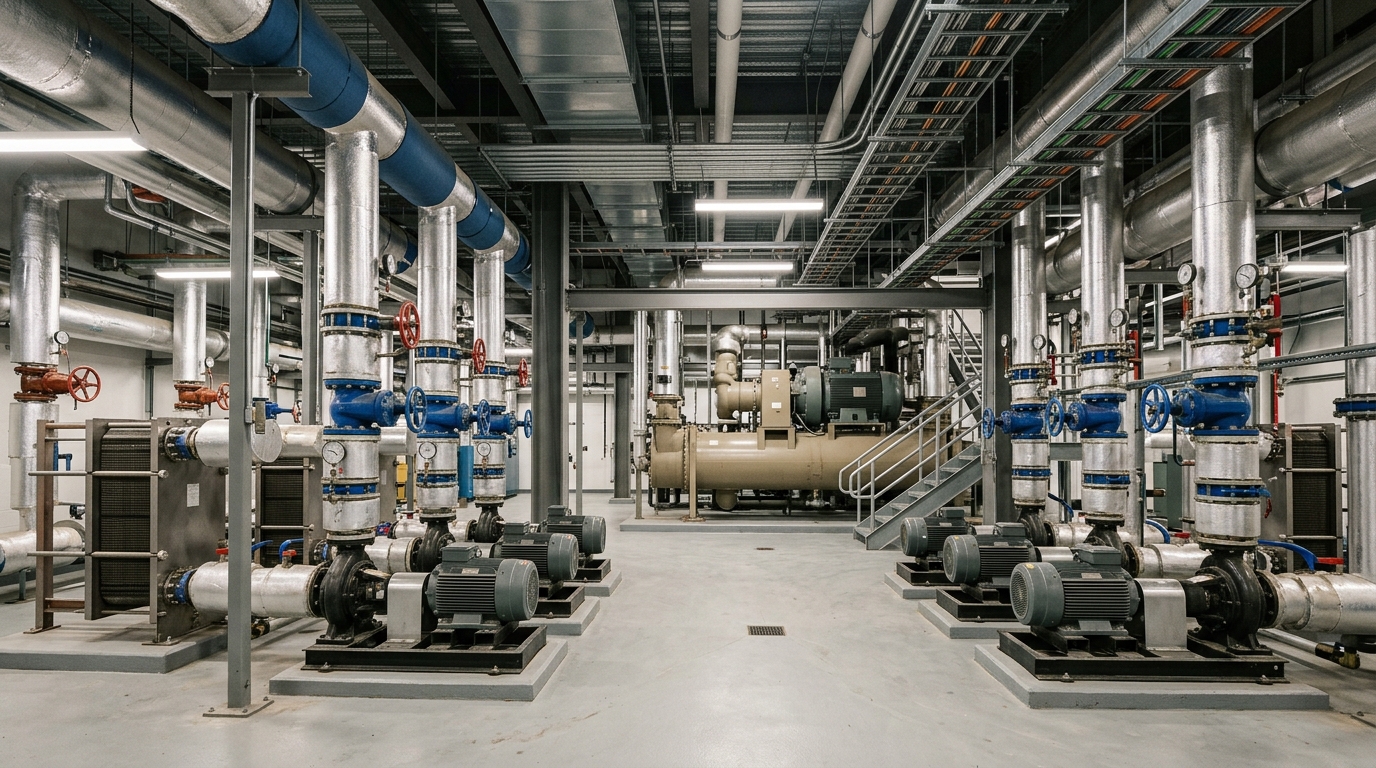
Calibrating Heat Extraction to Actual Load
Traditional data center mechanical systems were designed with massive safety margins, running oversized chillers and constant-speed pumps continuously. This legacy practice wastes huge amounts of electrical power and consumes millions of gallons of potable water in evaporative cooling towers.
GreenNext models precision cooling systems that replace brute-force refrigeration with thermodynamic elegance:
Direct-to-Chip Cold Plates
Water has 3,500 times the volumetric heat capacity of air. Liquid cold plates remove heat from 700W+ GPUs with minimal pumping energy and near-zero noise.
Closed-Loop Dry Heat Rejection
Closed-loop dry heat-rejection systems can avoid evaporative cooling-water consumption during operation when designed for the required ambient conditions and facility-water temperatures. Actual water usage effectiveness depends on system boundaries, auxiliary equipment, operating conditions, and any seasonal adiabatic or evaporative support.
Extended Free-Cooling Windows
Operating secondary fluid loops at elevated water temperatures, such as ASHRAE W32/W40/W45 liquid-cooling classes, may expand economizer hours; outcomes depend on equipment limits, climate, water quality, and heat-rejection design.
Thermodynamic Verification & Modeling
All cooling efficiency metrics describe GreenNext engineering models and thermodynamic calculations. Facilities implementing these designs can achieve dramatic PUE and WUE improvements compared to traditional legacy air-cooled facilities, while preserving local environmental ecosystems.
Continue Exploring Sustainability
Build the Next Generation of Digital Infrastructure
If you are involved in infrastructure planning, data center operations, AI workload management, or regional digital development across South India, we want to understand your requirements.